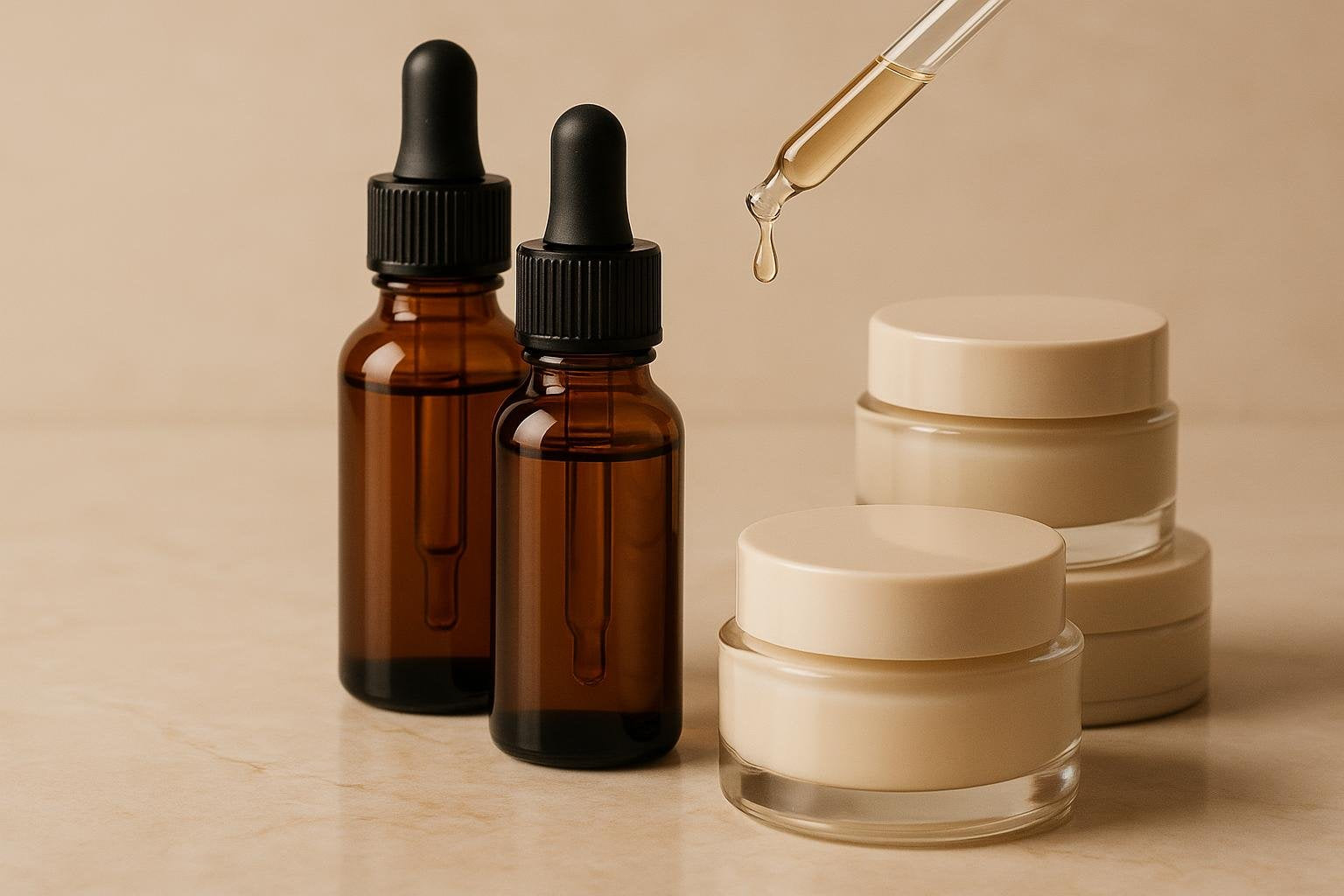
Red light therapy is a modality, not a complete routine. It works best as part of a stack — alongside antioxidants, retinoids, sunscreen, and moisturiser. But "alongside" raises practical questions: which product goes on before the LED session, which after, and which not at all on light-therapy days?
This is a practical guide to combining LED with the most common active skincare ingredients.
The general principle
Light penetrates skin best when nothing is blocking it. Heavy creams, makeup, sunscreen residue, and densely emulsified moisturisers can scatter or absorb LED wavelengths before they reach the dermis.
The default sequence: cleanse, dry, run the LED session, then apply your routine.
Vitamin C (L-ascorbic acid and derivatives)
Vitamin C is an antioxidant and an essential cofactor in collagen synthesis. It is generally a positive complement to red light therapy — both target the same downstream outcome.
Timing: Vitamin C is most studied as a morning antioxidant. Apply after the LED session. Some clinicians suggest the brief warming effect of LED may slightly enhance penetration of a serum applied immediately after, though this is not strongly evidenced.
Avoid: Applying L-ascorbic acid in a thick formula before the LED session. The serum acts as a barrier.
Retinoids (retinol, retinaldehyde, tretinoin)
Retinoids are among the most-studied collagen stimulators in dermatology. They are also the active most likely to cause skin irritation when introduced.
Timing: Retinoids are typically used at night. LED sessions can be at any time of day, but the order matters: LED first, then retinoid after.
Caution during introduction: If you are just starting a retinoid, your skin may be more reactive than usual. Some clinicians suggest reducing LED frequency during the first 2–4 weeks of a new retinoid until tolerance is established. If you notice irritation, drop one or the other temporarily.
Once tolerated: Retinoids and LED therapy are complementary — they stimulate collagen through different pathways and are typically additive rather than redundant.
Hyaluronic acid and moisturisers
Hyaluronic acid is a humectant. It does not block light at the wavelengths used in LED phototherapy in any meaningful way, but a heavy occlusive moisturiser layered over it can.
Timing: Apply after the LED session. The session itself can transiently dry the skin (LED produces mild warming); follow with a hydrating serum and your moisturiser.
AHAs and BHAs (glycolic, lactic, salicylic acid)
Chemical exfoliants thin the stratum corneum, which can transiently increase skin sensitivity to other stimuli, including light.
Timing: Do not apply AHA/BHA products immediately before an LED session. If you use them, apply at a different time of day, or on alternating days.
Caution: If your skin is currently in a sensitive phase from heavy exfoliation, reduce LED frequency until skin calms.
Sunscreen
Sunscreen is critical, but it is not relevant during the LED session itself (most consumer LED masks operate without UV emission). Apply sunscreen after the morning session, after the rest of your routine.
Note: red light therapy is not a UV source. It does not require photoprotection against itself. The sunscreen recommendation is about ongoing UV exposure throughout the day.
Niacinamide
Niacinamide is well-tolerated and compatible with LED therapy. Apply after the session in your normal routine.
Peptides
Peptides are large molecules. Like vitamin C, they are best applied to clean skin after the LED session, not before.
What to skip on LED days
Generally, none of the above need to be skipped entirely. The two situations that warrant caution:
- Active heavy exfoliation (recently started AHA at high concentration, or recent in-clinic peel). Wait until skin recovers before resuming LED.
- Acute irritation from any cause. Pause LED until the skin is calm.
A sample evening routine
- Cleanse, dry skin.
- 10-minute LED session.
- Hydrating toner or essence (optional).
- Targeted serum (peptide, niacinamide, or hydrating).
- Retinoid (every 2–3 nights, depending on tolerance).
- Moisturiser.
This is one workable sequence among many. The right routine is the one you can sustain.
The mask
Fits the routine you already have.
Ten minutes after cleansing, before serums. Wireless, USB-C, designed for daily integration.
Shop the maskReferences
Pullar JM, Carr AC, Vissers MCM. The roles of vitamin C in skin health. Nutrients, 2017.
Mukherjee S, Date A, Patravale V, et al. Retinoids in the treatment of skin aging. Clinical Interventions in Aging, 2006.
Redermis is a personal-care device, not a medical device. We make no claim to diagnose, treat, cure, or prevent any condition. Consult a healthcare professional if you have specific skin concerns.