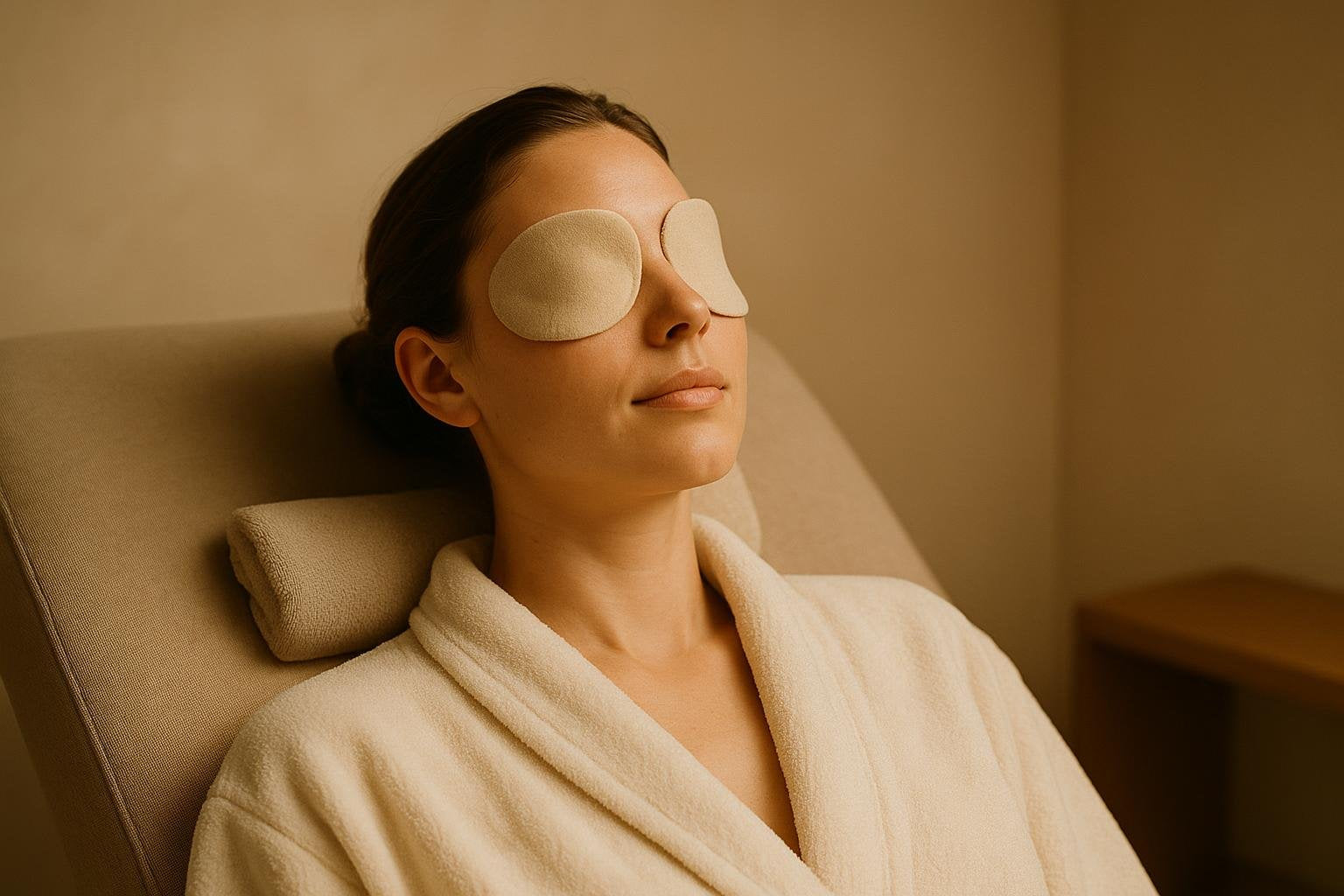
LED phototherapy at the wavelengths used in consumer face-and-neck masks has a strong safety profile. The published literature, including multi-week clinical trials, reports very few adverse events and no serious safety signals. That said, it is not the right tool for everyone, and some practical precautions matter.
This is a direct guide to the most common safety questions.
Eye safety
The eyes are the most light-sensitive part of the body. LED light at the intensities used in consumer masks is not the same as direct laser exposure, but it can be uncomfortable and prolonged direct exposure should be avoided.
Practical recommendations:
- Keep your eyes closed during the session. LED masks are designed to cover the eye region with the lights pointing outward at the skin, not inward at the eyes, but closing your eyes is the simplest insurance.
- Use eye-protection patches if your device includes them, particularly if you have light sensitivity.
- Pre-existing eye conditions: If you have retinal disease, recent eye surgery, or known photophobia, consult an ophthalmologist before using an LED mask.
Photosensitivity from medications
Some medications increase the skin's sensitivity to light. This includes both UV and, in some cases, visible-light photosensitivity. Common photosensitising agents:
- Certain antibiotics (tetracyclines, fluoroquinolones, sulfa drugs).
- Some diuretics and antihypertensives.
- NSAIDs (piroxicam, naproxen at high doses).
- Retinoid-class systemic medications (isotretinoin and similar).
- Some antiarrhythmic drugs (amiodarone).
- St. John's wort and certain other botanical supplements.
If you are on a medication you know to be photosensitising, consult your prescribing clinician before adding LED therapy. While most photosensitivity reactions are triggered by UV, visible-light sensitivity is documented for some agents.
Skin conditions that warrant caution
Several skin conditions involve increased sensitivity to light or unpredictable response to phototherapy:
- Lupus erythematosus and other photosensitive autoimmune conditions.
- Porphyria in any form.
- Polymorphic light eruption and other primary photodermatoses.
- Active rosacea flare (LED is sometimes used for rosacea, but during acute inflammation, caution is warranted; consult a dermatologist).
- Recent in-clinic procedures (laser, peel, microneedling): skin needs to heal before introducing new modalities.
- Open wounds, active infections, or undiagnosed skin lesions: see a doctor first.
Cancer history
If you have a history of skin cancer (melanoma in particular) or a current undiagnosed pigmented lesion, talk to your dermatologist before starting any new light-therapy regimen. While LED at consumer-mask intensity is not equivalent to UV exposure, it is sensible to involve a clinician who knows your full skin history.
Pregnancy and breastfeeding
There is limited published data specifically on LED phototherapy use during pregnancy. While LED at visible wavelengths is not known to be harmful to a developing fetus, in the absence of clear evidence, many manufacturers and clinicians recommend avoiding use during pregnancy as a precaution.
If you are pregnant or trying to conceive, consult your healthcare provider.
Pacemakers and implanted devices
LED phototherapy at the wavelengths and intensities used in consumer masks does not generate electromagnetic interference relevant to pacemakers or implanted defibrillators. The device emits visible light, not RF.
However: if you have any implanted medical device, check with your physician before introducing any new device into your routine. Generic advice cannot substitute for individual medical guidance.
Side effects to expect (mild)
The most commonly reported side effects from consumer LED therapy are mild and transient:
- Mild warming or slight skin flush during the session — normal, resolves quickly.
- Transient redness for a few minutes after the session — particularly in those with reactive or sensitive skin.
- Slight skin dryness with prolonged use — typically managed by following up with a hydrating skincare routine.
- Eye fatigue if you do not close your eyes during the session.
Side effects that warrant stopping
Stop the device and consult a clinician if you experience:
- Persistent redness or rash that lasts more than 24 hours after a session.
- Skin pain or burning during use.
- Worsening of an existing skin condition.
- Visual disturbance.
These are not common with LED phototherapy at consumer-device intensities, but the right response to any of them is to stop and seek advice.
The honest summary
LED phototherapy at the wavelengths and intensities used in consumer face-and-neck masks is generally well tolerated. It is not a high-risk modality. Most people can use it daily without issue.
It is also not a medical treatment. If you have a specific skin condition, see a dermatologist. If you are on photosensitising medications, ask your prescriber. If you are pregnant or have a history of skin cancer, consult your doctor before adding it to your routine.
The mask
Designed for daily use.
Redermis is a personal-care device for at-home photorejuvenation. Read the included guidance and consult a clinician if you have specific concerns.
Shop the maskReferences
Avci P, Gupta A, Sadasivam M, et al. Low-level laser (light) therapy in skin: stimulating, healing, restoring. Seminars in Cutaneous Medicine and Surgery, 2013.
Drucker AM, Rosen CF. Drug-induced photosensitivity: culprit drugs, management and prevention. Drug Safety, 2011.
Redermis is a personal-care device, not a medical device. We make no claim to diagnose, treat, cure, or prevent any condition. This article is general information, not medical advice. Consult a qualified healthcare professional for guidance on your specific situation.