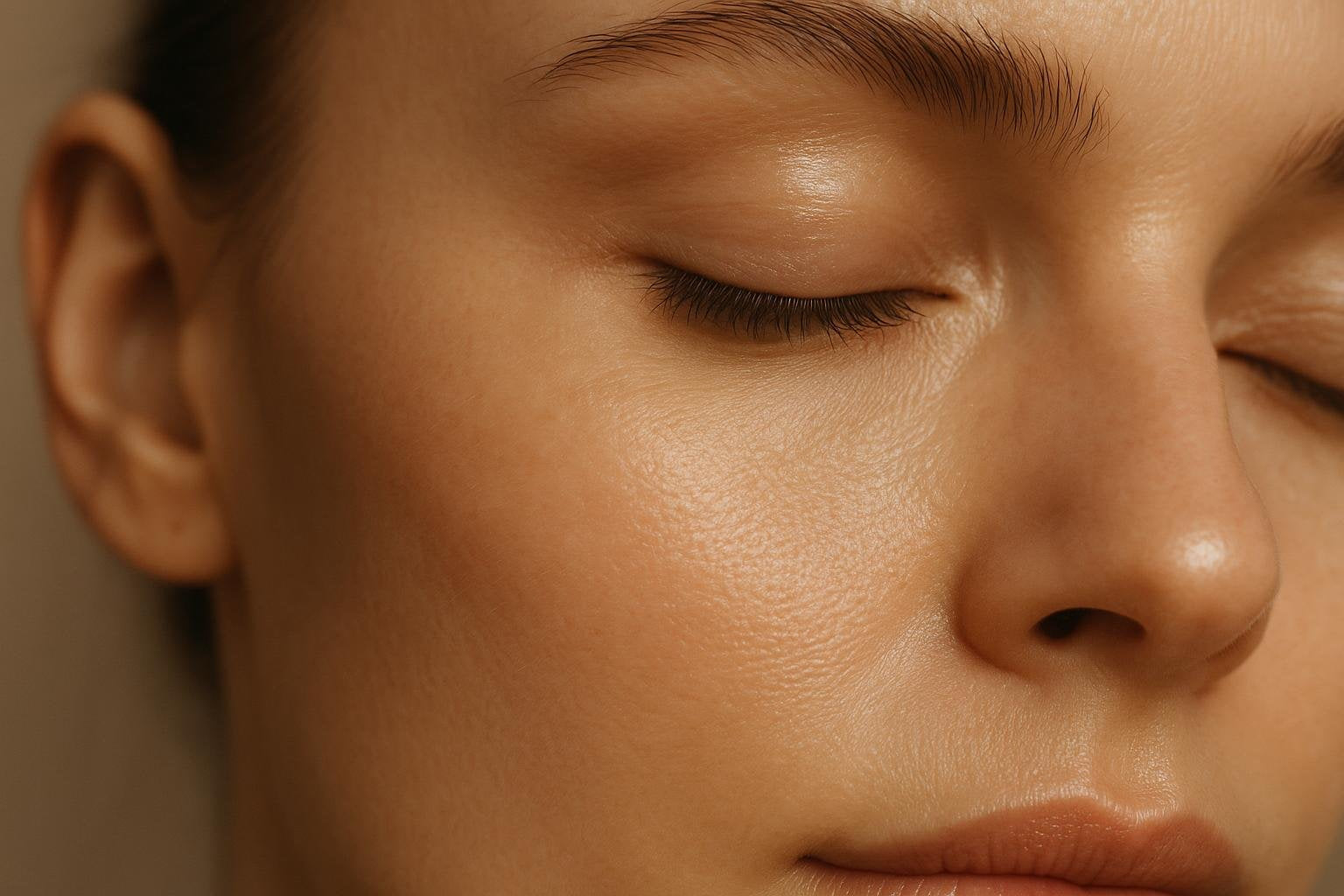
"Fine lines" is the language of skincare marketing. At the cellular level, what we are looking at is the slow rearrangement of the dermal matrix — fewer and shorter collagen fibres, disorganised elastin, reduced hyaluronic acid, and a thinning of the dermis itself.
Red light therapy works at this layer. The question is: by how much, and how reliably?
What collagen does in the skin
Type I collagen makes up around 80% of the protein content of the dermis. Type III is also present, particularly in younger skin and during wound healing. Together they form a fibrous mesh that gives skin its tensile strength and its ability to spring back when stretched.
From around age 20, collagen production declines at roughly 1% per year. By 50, the dermal collagen content is meaningfully lower than it was at 25. Photoaging from UV exposure accelerates this further — the rate of degradation outpaces the rate of new synthesis.
The visible result is the appearance of fine lines, loss of firmness, and the slow appearance of slack in areas under repeated mechanical load (around the eyes, the nasolabial folds, the mouth).
How red light intervenes
Red wavelengths in the 600–700 nm range penetrate to the dermis and are absorbed by cytochrome c oxidase inside fibroblast mitochondria. The downstream effect on fibroblasts has been studied in vitro and in vivo:
- Increased synthesis of pro-collagen I and pro-collagen III.
- Increased production of elastin.
- Reduced expression of matrix metalloproteinases (the enzymes that break down existing collagen).
This is the biochemical case for red light photorejuvenation. The clinical case is the question of whether these cellular changes translate to measurable improvement in real skin on real participants.
The controlled trial
One of the more rigorous studies on this question is Wunsch & Matuschka (2014), published in Photomedicine and Laser Surgery. It was a controlled trial of LED phototherapy at red and near-infrared wavelengths, conducted over 30 sessions, with a control group that received no treatment.
Outcomes measured:
- Intradermal collagen density, measured by ultrasonographic imaging. Statistically significant increase in the treatment group vs. control.
- Patient-reported improvement in skin smoothness and the appearance of fine lines.
- Skin roughness, measured digitally. Improvement in the treatment group.
This is one study. It does not prove that any LED device produces the same result. What it does establish is that, under controlled conditions, red-wavelength LED treatment can produce measurable changes in the dermal matrix.
What this looks like in practice
The improvements are gradual. The biological process of producing new collagen takes weeks. Most clinical protocols use 3–5 sessions per week for several weeks to see initial change, with maintenance sessions after.
"Visibly different skin" — to the extent it happens — is the cumulative result of many sessions, not one.
The mask
Targeted at the dermis. Daily, at home.
Redermis fires red, green, and blue LEDs across 309 emission points covering face and neck. Ten-minute sessions.
Shop the maskReferences
Wunsch A, Matuschka K. A controlled trial to determine the efficacy of red and near-infrared light treatment in patient satisfaction, reduction of fine lines, wrinkles, skin roughness, and intradermal collagen density increase. Photomedicine and Laser Surgery, 2014.
Lee SY, Park KH, Choi JW, et al. A prospective, randomized, placebo-controlled, double-blinded, and split-face clinical study on LED phototherapy for skin rejuvenation. Journal of Photochemistry and Photobiology B, 2007.
Redermis is a personal-care device, not a medical device. We make no claim to diagnose, treat, cure, or prevent any condition. Individual results vary.