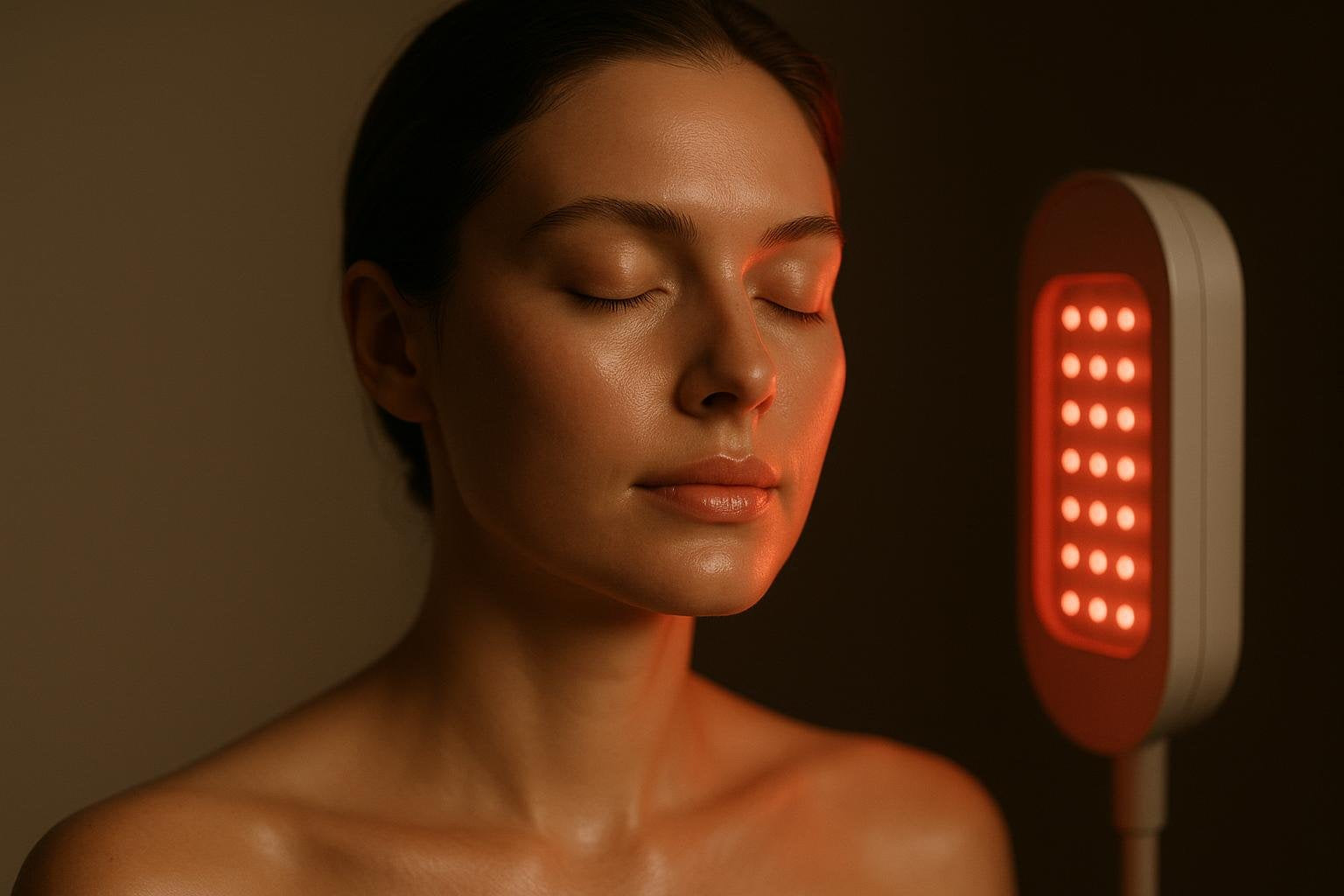
Light is not just an environmental signal for the eyes. Specific wavelengths of light pass through the surface of the skin and interact with structures inside cells — particularly the mitochondria. The biological effect of this interaction has a name: photobiomodulation.
Understanding the mechanism matters. It is the difference between a marketing claim and a working device.
Where the light goes
The skin is layered. The outer epidermis is around 0.1 mm thick on the face. Below it sits the dermis — the connective layer where collagen and elastin are produced — which can be 1–4 mm thick depending on the area of the body.
Different wavelengths of visible light penetrate to different depths:
- Blue light (around 400–470 nm) stops in the epidermis. It does not reach the dermal cells that build collagen.
- Green light (around 500–560 nm) reaches slightly deeper than blue but is still relatively superficial.
- Red light (around 600–700 nm) penetrates several millimetres into the dermis. This is the wavelength range with the most established photorejuvenation research.
- Near-infrared (NIR, around 800–900 nm) penetrates further still, into the subcutaneous tissue.
For photorejuvenation of facial skin, red wavelengths sit at the depth where they can interact with fibroblasts — the cells that produce new collagen and elastin.
What happens inside the cell
The leading hypothesis for how red and near-infrared light produce a biological response involves a specific enzyme: cytochrome c oxidase, part of the electron transport chain in mitochondria.
Cytochrome c oxidase absorbs photons in the 600–900 nm range. When it does, several downstream effects have been documented in published research:
- A transient increase in ATP production (the cell's energy currency).
- A brief, controlled release of reactive oxygen species, which act as signalling molecules.
- Release of nitric oxide from the enzyme, with effects on local blood flow and intracellular signalling.
- Activation of transcription factors that influence gene expression related to repair and proliferation.
In fibroblasts specifically, these changes are associated with increased synthesis of collagen and elastin — the proteins responsible for skin firmness and elasticity.
Why dose matters
Photobiomodulation is biphasic. Low to moderate doses are associated with the positive effects above. Higher doses can inhibit the same processes. This is sometimes referred to as the Arndt-Schulz law in the photobiomodulation literature.
Practically, this means session length and irradiance matter. Longer is not better. Most clinical protocols use sessions in the 10–20 minute range, several times a week.
What this means for the visible result
The effect of photobiomodulation accumulates. A single session changes cellular signalling. Visible improvements in fine-line appearance, texture, and tone develop over weeks of consistent use, as new collagen is produced and the dermal matrix is reshaped.
This is not a quick fix. It is a slow, biological process driven by light reaching the right cells at the right intensity.
The mask
Bring the science home.
Redermis combines seven LED wavelengths in a single wireless mask. Ten minutes a day, at home, on your schedule.
Shop the maskReferences
Hamblin MR. Mechanisms and applications of the anti-inflammatory effects of photobiomodulation. AIMS Biophysics, 2017.
Avci P, Gupta A, Sadasivam M, et al. Low-level laser (light) therapy (LLLT) in skin: stimulating, healing, restoring. Seminars in Cutaneous Medicine and Surgery, 2013.
Redermis is a personal-care device, not a medical device. We make no claim to diagnose, treat, cure, or prevent any condition.